

FINE ART PHOTOGRAPHY OF 24K GOLD · 1934 FORD HOT ROD COUPE · LUXCAST #186
Negative Space and the Outlaw Silhouette
Sometimes the most important part of a hot rod photograph is the air around the car.
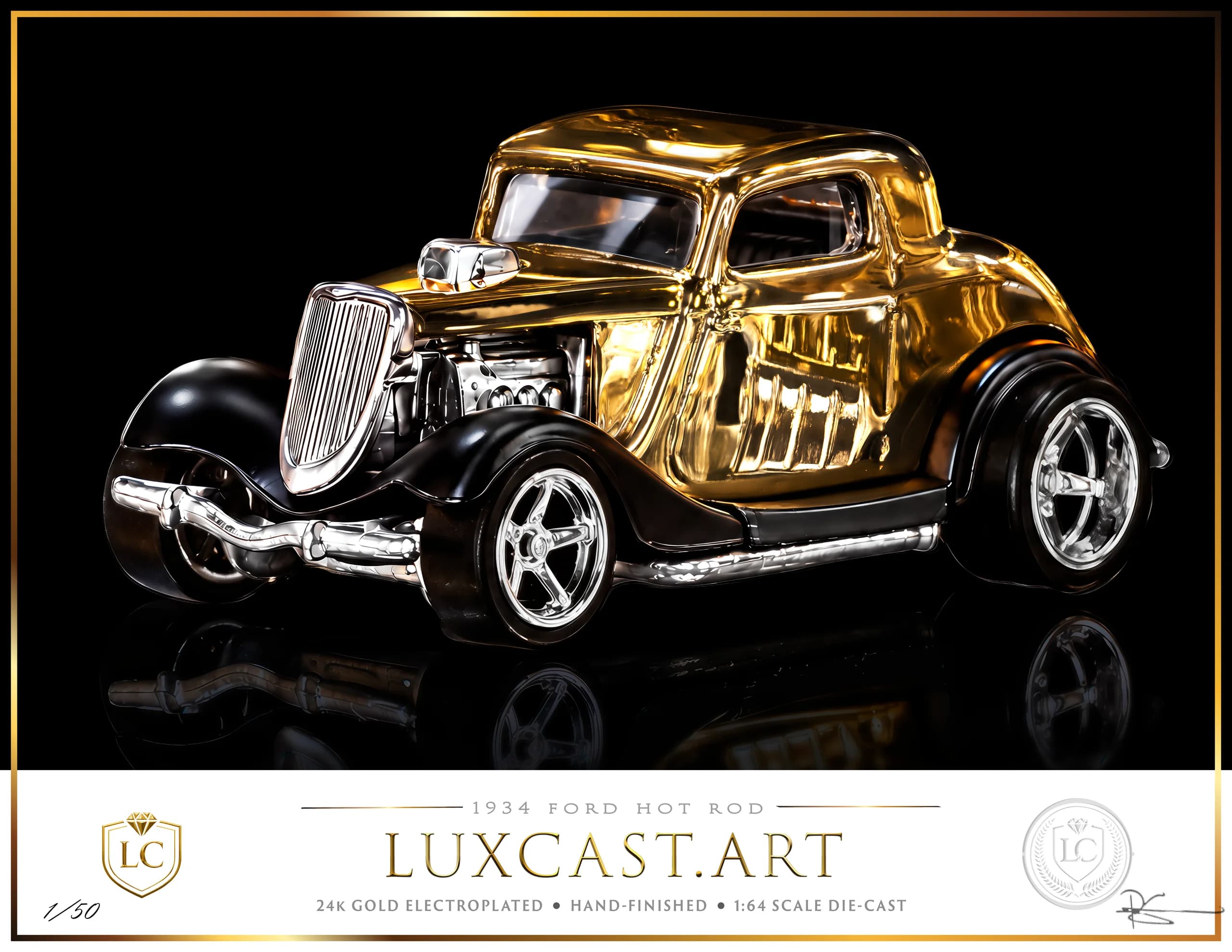
What gives a great hot rod its silhouette? Sometimes it's the parts the builder removed. A lower roof, exposed wheel or stripped fender changes not only the car but the pockets of empty space around it. Those gaps are where a photograph can become graphic art.
The Shape Is Also What Is Missing
Examine the empty air around the Hot Rod’s front axle in the actual Luxcast photograph. The black fenders, low central body and exposed mechanical parts create small windows of darkness. Those spaces are not background mistakes. They let the eye separate wheel, engine, body and side exhaust as distinct sculptural pieces. Meanwhile, 24K gold changes abruptly to near-black where the body turns away from the lights. The resulting photograph reads almost like a charcoal study with precious-metal punctuation. Put a solid body panel across those openings and much of the image’s rhythm would vanish.
What the Eye Notices First
A prewar Ford coupe already offers appealing contrasts: a compact cabin, a rounded roof, separate-looking fenders, and a short, purposeful nose. Classic hot-rod modifications can change that visual balance radically. Lower the roof and the side windows become narrow bands. Move the body closer to the chassis and the empty gap beneath it shrinks.
The dark slot between a black fender and the gold body is easier to overlook than the engine, but it is what keeps the mechanical parts from merging into one bright mass. That void remains legible even when the details around it throw complicated reflections. Photographers call it negative space: a shape made from what isn't part of the car. Here the studio's black background becomes almost another fabricated component.
The best hot-rod photograph knows when the most interesting part of the car is the air the metal leaves behind.