

FINE ART PHOTOGRAPHY OF 24K GOLD · 1973 CHEVROLET CORVETTE · LUXCAST #147
The Long Hood and the Mathematics of a Highlight
Why a Corvette's curves can turn a strip of light into a landscape.
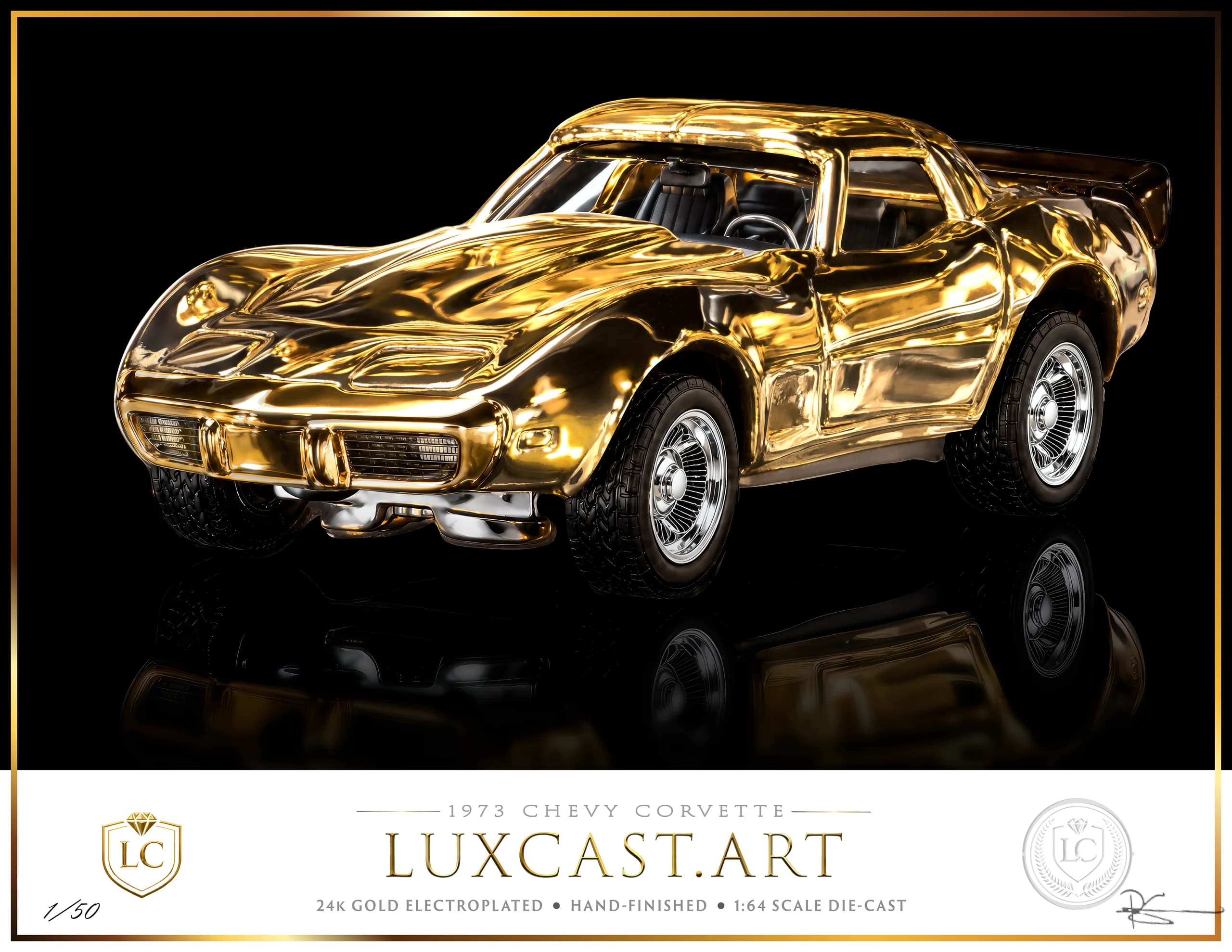
The 1973 Corvette has a curve that refuses to sit quietly in a photograph: a hood long enough to turn a single reflected light into several different shapes. Follow those changes, and the eye begins to read the car less as a silhouette than as a sculpture made from continuously shifting angles.
Follow the Real Highlight
Start at the tip of the pictured Corvette’s long gold hood. Your eye moves along an interrupted dark seam, then catches a broad, lighter reflection climbing toward the windshield. The front wheel arch cuts across the pattern at nearly a right angle. That is not a painted stripe; it is evidence that a curved metal surface is meeting the studio from several directions.
Two Materials, One Metal
Imagine making that photograph of the full-size car: the soft body-colored front bumper would answer the light differently from the rear chrome. On this gold-plated miniature, that material contrast is gone. The nose must identify itself by contour, the rear by outline, and the hood by the long light it bends between them.
And because the 1973 Corvette wears such pronounced shoulders, the reflections can change quickly across a surprisingly small area. Light describes the surface one highlight at a time.
The Eye Fills in the Rest
Look at the dark line beside the wheel opening: it makes the adjacent gold arch seem to lift toward you. One bright stripe on the hood does the opposite, flattening momentarily before bending as the panel curves. The viewer reconstructs depth from those changes without needing to see the Corvette from a second angle.
One long Corvette hood, countless viewing angles. The studio chooses which few the photograph reveals.